The History of Menuiserie de Parquet
— the Floor Beneath the Finest Feet
The Floor Beneath Kings, Palaces and the Finest Feet of Europe
Long before parquet became a symbol of refinement, Europe’s castles and palaces were monuments of stone — magnificent, imposing, ceremonial… and cold.
Beneath the feet of kings, queens, aristocrats and diplomats stretched endless surfaces of marble, limestone and rough timber planks. Grand architecture had conquered visual splendor, yet true domestic comfort remained elusive. It was precisely within this search for warmth, elegance and civilized living that one of Europe’s most refined crafts would emerge: menuiserie de parquet.
Parquet was never conceived as an ordinary floor.
From its very beginning, it belonged to a world of elevated living, architectural sophistication and ceremonial beauty. It was created for the most distinguished interiors of Europe — for palaces, hôtels particuliers, noble residences and the salons of the cultured elite. The floor itself became an extension of architecture, furniture, music, etiquette and movement. A stage upon which life unfolded.
The very word parquet originates from the French parchet, referring to a small enclosed space or compartment. Over time, the term evolved into the intricate geometric flooring compositions that became synonymous with French decorative arts during the 17th century.
It was in France, particularly under the reign of Louis XIV, that parquet reached extraordinary prominence. The monumental halls of the Palace of Versailles demanded floors worthy of their architectural ambition. Marble, although visually impressive, proved difficult to maintain and uncomfortable within lived spaces. Wood, by contrast, offered warmth, acoustic softness, resilience and sensuality beneath the foot.
Thus emerged the great age of parquetry.
Master craftsmen — menuisiers de parquet — developed astonishing geometric compositions assembled from carefully selected woods: oak, walnut, elm, chestnut and exotic imported species arriving through Europe’s expanding trade routes. Floors became compositions of rhythm and proportion, almost musical in nature. Rosettes, windroses, star patterns and woven geometries transformed surfaces into living ornamentation.
Yet the true mastery of parquet never resided merely in pattern.
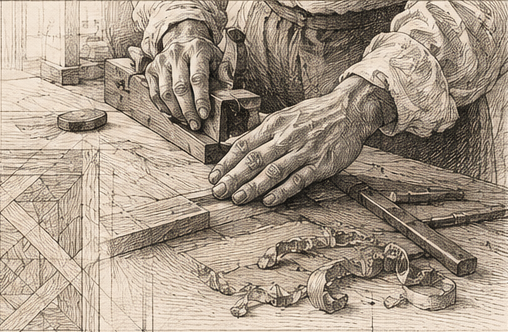
It lived in the hand.
A genuine parquet floor is not manufactured in the industrial sense. It is composed. Interpreted. Balanced. Felt. Every plank possesses its own density, grain, humidity, tension and behavior. The craftsman must understand not only geometry and woodworking, but also movement, light, aging, acoustics and atmosphere.
This is why authentic parquetry belongs to the same cultural family as violin making, sculpture, cabinetmaking and classical music.
Machines may reproduce repetition. They cannot reproduce sensitivity.
The great menuisier de parquet understands something deeper: perfection in craftsmanship is never sterile. The soul of the work emerges precisely through the subtle humanity of the process itself — the slight variation in grain, the instinctive adjustment made during installation, the way natural oils are absorbed differently from plank to plank, the almost invisible irregularities that make a floor breathe with life rather than resemble a printed surface.
True parquet is therefore not merely seen. It is experienced.
One does not simply walk across a great parquet floor. One lives with it. Morning light reveals new reflections within the grain. Seasons subtly influence tone and texture. Time itself enriches the surface rather than diminishing it. Unlike synthetic materials that deteriorate toward obsolescence, authentic parquet matures toward character.
For centuries, parquet remained associated with Europe’s highest forms of living. Palaces, embassies, theatres, libraries, aristocratic townhouses and cultural institutions all embraced parquet not only for prestige, but because no other surface united warmth, acoustics, elegance and durability in quite the same way.
Even today, despite industrial imitation and mass-produced alternatives, genuine handcrafted parquet remains the uncontested summit of flooring artistry.
It is often called the champagne amongst floors — and not without reason.
There is a profound sensuality to parquet that few materials can rival. To wake in the morning and place one’s feet upon a finely crafted wooden floor is an experience both grounding and uplifting. The material responds with warmth, softness and quiet resonance. It does not merely support movement — it accompanies it.
Almost like dancing through life.
And behind every truly exceptional parquet floor stands the rare figure of the maître menuisier de parquet: the craftsman capable of transforming raw timber into architectural poetry.
These masters belong to a lineage that stretches back centuries. A tradition carried not only through tools and techniques, but through discipline, observation, transmitted knowledge and devotion to material itself. Their work exists at the intersection of architecture, engineering, decorative art and human emotion.
In an era increasingly dominated by automation, synthetic materials and disposable interiors, authentic parquet craftsmanship remains one of the last great expressions of living European mastercraft.
Not because it resists modernity.
But because certain forms of beauty can only emerge through the intelligence of the human hand.