The Roots of a Grand Tradition — Antwerp & Mechelen


The Roots of a Grand Tradition
Antwerp, Mechelen and the European World of Craft
Long before craftsmanship became a word associated with exclusivity, it was part of the very structure of European urban life.
In the cities of Flanders and the Southern Netherlands, the late Middle Ages saw craftsmen organize themselves into guilds in which knowledge, quality and reputation were carefully guarded. A craft was not simply an occupation. It was a discipline, learned through years of practice and passed from master to apprentice. The right to call oneself a master had to be earned.
Antwerp and Mechelen are the ideal setting for this tradition—Antwerp was the heart of European craftsmanship, art, and trade in the earliest days of the global catwalk. The explosion of fashionable ideas and the enriching eclecticism of bringing inspirations from all over the world together.
The two connected cities developed distinct but complementary identities. Mechelen became renowned as a city of skilled production and refined manufacture. Antwerp developed into one of the great international marketplaces of Renaissance Europe — a place where goods, ideas, art and craftsmanship were not only traded, but presented to the world.
One made. The other connected.
Mechelen was the atelier. Antwerp was the stage.
Between them, and within the wider cultural landscape of the Southern Netherlands, emerged an extraordinary environment in which craftsmanship, architecture, commerce and art continuously reinforced one another.
It is within this tradition that Oud Huys Schoenaers finds both its historical roots and its contemporary purpose.
Mechelen — A City That Made Things
The history of Mechelen is inseparable from the history of making.
Already during the Middle Ages, the city and its surrounding districts developed important textile industries. Over succeeding centuries, its craftsmen became renowned far beyond the city for an extraordinary range of luxury and specialist products: furniture and woodcarving, gilt leather, lace, alabaster sculpture, bells and other highly skilled manufactures.
Even Nekkerspoel, today part of the urban fabric of Mechelen, possessed its own medieval history of organized craftsmanship. Such places were not simply concentrations of labour. They were environments in which knowledge circulated between generations and where the reputation of a craftsman depended upon the quality of what left his hands.
These were not anonymous industrial products. They belonged to a world in which objects carried the knowledge of the people who created them. Mechelen consequently developed something more valuable than any individual workshop: a culture of craftsmanship.
Knowledge travelled from master to apprentice, from workshop to workshop and, frequently, from one generation of a family to the next. Techniques evolved, styles changed and markets expanded, but the underlying principle remained remarkably constant: mastery resided in the combination of material knowledge, disciplined execution and an educated eye.
That culture survived long beyond the Renaissance. Mechelen’s furniture and woodworking traditions remained economically significant centuries later, preserving an association between the city and the skilled transformation of material.
It is within this much deeper landscape of craftsmanship that the story of Oud Huys Schoenaers belongs.
Antwerp — Where Craft Met the World
If Mechelen represented the extraordinary capacity to make, Antwerp provided access to a world eager to acquire, commission and admire.
During the sixteenth century, Antwerp developed into one of Europe’s foremost commercial cities. Merchants arrived from across the continent and beyond. Materials, commodities, capital, knowledge and works of art circulated through its streets, warehouses, workshops and trading houses.
The city became more than a port.
It became a marketplace of ideas — and a stage upon which value could be made visible.
Antwerp’s famous exchange, established in 1531, embodied this international world of commerce. But the city’s importance reached far beyond financial exchange. Antwerp became one of Europe’s great centres of artistic production and dissemination. Painters, printers, sculptors, goldsmiths, cabinetmakers and countless other craftsmen worked within an environment where art, craft and commerce existed in unusually close proximity.
Antwerp understood something that remains remarkably contemporary: mastery acquires greater reach when it is given a stage.
Works had to be seen. Patrons had to encounter craftsmen. Merchants needed places in which goods could be discovered, compared and commissioned. Artists needed audiences and markets. The city developed an extraordinary capacity not only to trade what was made, but to communicate its desirability and cultural value.
In modern terminology we might call this presentation, positioning or even storytelling.
In Renaissance Antwerp, it was simply part of how the city worked.
Prosperous merchants, aristocratic households, ecclesiastical institutions and courts demanded increasingly sophisticated surroundings. Architecture became more than shelter. Interiors communicated culture, status, education and permanence.
Within that world, craftsmanship could rise beyond utility. It could become representation.
From Craft to Architectural Art
As European interiors became increasingly sophisticated during the Renaissance and, particularly, from the seventeenth century onward, woodworking developed into ever more specialized disciplines.
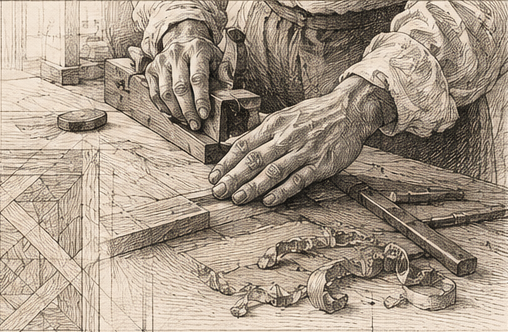
Cabinetmaking, carving, panelling and the creation of sophisticated wooden floors required an extraordinary command of material and geometry. What had once been primarily functional could become architectural composition.
Within the great houses, hôtels particuliers, castles and palaces of Europe, parquet reached exceptional levels of refinement.
Geometric arrangements, borders, medallions, rosettes and elaborate compositions transformed the floor into an integral part of the architecture. Such work demanded considerably more than the ability to lay timber. It required understanding of proportion, perspective, movement, wood species, grain, colour and the architectural space for which the work was intended.
At this level, the parquet craftsman participated in the creation of the room itself.
The distinction is fundamental. A floor covers a surface. Master parquet defines a space.
The most accomplished parquet therefore belongs to the same historical continuum as fine cabinetmaking, carving and architectural ornament: disciplines in which practical purpose and artistic intelligence become inseparable.
Its function does not diminish its artistic value. Its function makes that value part of everyday life.
The Master and the Transmission of Knowledge
The old European craft tradition rested upon something that modern industrial production can reproduce only with difficulty: the transmission of knowledge through human hands.
The master did not merely teach a sequence of operations. He transmitted judgement.
How wood behaves. How different species respond. How proportions interact. How a border resolves a composition. When geometry requires ornament and when it requires restraint. How a historical floor should be approached when preservation matters more than replacement. How an imperfection in a material can become part of its character rather than something to be eliminated.
Such knowledge accumulates over decades.
Much of it can be documented, but not all of it can be learned from documentation. It resides in the eye, in the hand and ultimately in the judgement of the craftsman.
That is why the traditional relationship between master and apprentice mattered so profoundly. And it is why specialized craft knowledge can disappear remarkably quickly once the chain between generations is broken.
It is here that the legacy of Joannes Schoenaers acquires its particular meaning.
His mastery belongs to that much older European understanding of the craftsman.
A Tradition That Became Today's Scarce Sacred Gold
The guilds themselves belong to history. The culture that created them does not.
Walk through Antwerp or Mechelen today and the evidence remains everywhere: façades, churches, townhouses, palaces, carved interiors, furniture, floors and architectural details produced during periods when the distinction between artist and craftsman was considerably less rigid than it later became.
That inheritance also creates a remarkably contemporary economic reality.
Europe possesses an enormous stock of historic buildings requiring restoration, adaptation and sensitive redevelopment. Castles, townhouses, monumental residences and protected interiors cannot always be served adequately by standardized construction methods. They require knowledge of materials, techniques and architectural languages that have become increasingly scarce.
At the same time, another market has developed alongside historical restoration.
At the highest end of contemporary residential architecture, clients, architects and developers are rediscovering the value of authentic materials, bespoke work and identifiable craftsmanship. In a world capable of manufacturing almost anything at enormous scale, the individually conceived and expertly made object has acquired renewed significance. The paradox is striking.
Demand for authenticity is increasing precisely when the number of people capable of authentically producing or restoring such work has become scarce.
What was once knowledge shared within a guild has become specialist knowledge.
And specialist knowledge has value.
Mechelen — The Atelier
For Oud Huys Schoenaers, Mechelen is therefore considerably more than an operational location.
It represents the atelier.
Antwerp — The Stage
Centuries after Antwerp first established itself as a place where craftsmanship, art and commerce encountered an international audience, Oud Huys Schoenaers consciously returns to that tradition at the mastercraft house.
The Mastercraft House is conceived as the Antwerp manifestation of the house: a craftsmanship exposition space in the historic heart of the city.
It is deliberately not conceived as a conventional flooring showroom, but as an exposition.
The Mastercraft House thus becomes more than an exposition space. It becomes a contemporary interpretation of Antwerp’s historic role as a place of encounter — between maker and patron, craft and architecture, heritage and contemporary design, Europe and the wider world.
Architects can encounter the possibilities of the craft there. Restoration professionals can discuss historical applications. Developers can imagine compositions within new projects. Private clients can experience the difference between selecting a flooring product and commissioning a work.
The house gives craftsmanship a stage.
From the Atelier to the World
The relationship between Mechelen and Antwerp consequently becomes part of the architecture of Oud Huys Schoenaers itself.
Mechelen makes. Antwerp manifests.
The atelier safeguards the knowledge and creates the work. The Mastercraft House places that work before architects, developers, patrons and an international audience.
From there, the movement continues outward.
The historical restoration market provides one natural field of activity. The contemporary high-end interior and residential markets provide another. Beyond Europe, the tradition acquires yet another meaning: authentic European craftsmanship becomes increasingly distinctive in architectural markets where provenance, individuality and cultural depth contribute directly to perceived value.
This is particularly relevant to international architecture and luxury residential development.
European heritage cannot simply be manufactured as a stylistic effect. It has roots.
Those roots lie in cities, workshops, generations of craftsmen, surviving buildings, inherited techniques and a cultural understanding of architecture that developed over centuries.
Oud Huys Schoenaers does not seek to imitate those roots. It emerges from them.